FREE Royal Mail · 2–3 daysGMP quality standardsMade in the UKVAT included
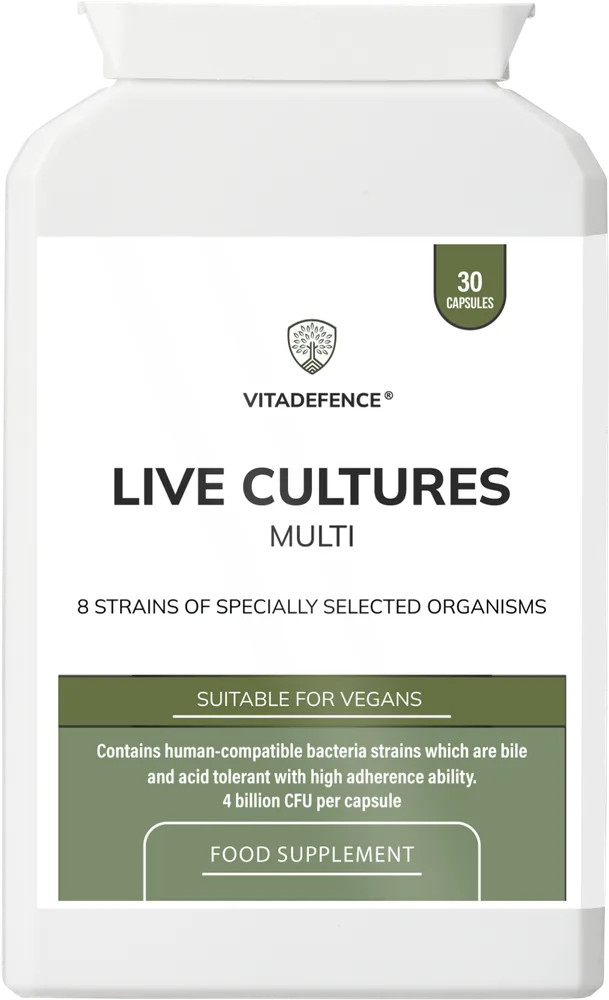
Live cultures & enzymes · 100% Plant-based · Vegan · 8 Strains, 4 Billion CFU · 30 Capsules
| Lactobacillus rhamnosus |
| Lactobacillus casei |
| Lactobacillus acidophilus |
| Bifidobacterium infantis |
| Streptococcus thermophilus |
| Bifidobacterium breve |
| Bifidobacterium longum |
| Lactobacillus bulgaricus |
Capsule Shell: Hydroxypropyl Methylcellulose (HMPC); Brown Rice Flour (Oryza Sativa); Bio-Live Bacteria Blend: Lactobacillus rhamnosus, Lactobacillus casei, Lactobacillus acidophillus, Bifidobacterium infantis, Streptococcus thermophilus, Bifdobacterium breve, Bifidobacterium longum, Lactobacillus bulgaricus.
4 billion viable organisms per capsule.
Take 1 capsule, 1 to 3 times per day before meals or as advised. If this live bacteria biotic is taken alone (as opposed to in combination with other digestive health supplements), start off with a higher intake of 3 - 4 capsules, split up throughout the day with food for 2 - 4 weeks. Thereafter, intake to be reduced to 1 capsule, 1 to 2 times per day. Best results are achieved when: it is combined with other digestive health supplements and intestinal products and is taken continuously for 2 - 3 months, together with improved eating habits. Does not require refrigeration. NOTE: Included in each pot is a small food grade approved sachet to ensure the product remains unaffected by moisture after it is opened for use. As stated on the sachet, this is not to be eaten.
Store in a cool, dry place, out of reach of children. Do not use if the seal is damaged. Best before date printed on the base.
Suitable for vegetarians and vegans · Kosher approved · Halal approved
Most of what your gut does, it does quietly. Trillions of microorganisms — bacteria, archaea, fungi, the occasional virus — share the inside of your digestive tract, and on most ordinary days they hold themselves in a steady balance you don't have to think about. They digest the fibre your own enzymes can't break down. They make small amounts of vitamins K and several Bs.
For a higher count, see Live Cultures Max (20 billion CFU). This is the everyday version. Four billion live organisms per capsule, eight strains, one capsule a day, taken on quiet repeat for as long as the kitchen cupboard holds it.
A clean cream pot, the green band of our label running around it. Thirty plant-fibre capsules inside — a one-month supply at one capsule a day. The capsules are HPMC — hydroxypropyl methylcellulose, a plant-derived shell — so the bottle is suitable for vegans, vegetarians, and any kosher or halal kitchen.
Inside each capsule, four billion freeze-dried, viable organisms held in brown rice flour. The capsule holds brown rice flour with the cultures. The first sip of water you take after the capsule is what wakes them up.
No refrigeration needed. The freeze-drying and the moisture-control sachet inside the bottle keep the organisms viable at room temperature.
The strength of a probiotic is not a contest. More CFU is not automatically better — there is a point above which the gut simply doesn't have room for new arrivals to settle, and the surplus passes through.
Each capsule holds 4 billion viable organisms. The kind of number that makes sense as a steady drip, week after week, the way you might top up a garden bird-feeder.
Four billion is for the rest of the year. If you have just finished a course of our high-strength bottle, this is the natural step-down. If you are starting probiotics for the first time without any particular crisis to address, this is the right starting dose.
Eight species from the Lactobacillus, Bifidobacterium and Streptococcus groups.
Lactobacillus casei. A versatile fermenter found in cultured dairy.
Lactobacillus acidophilus. The original household-name probiotic, in yoghurt cultures since the 1920s.
Bifidobacterium infantis. A colon resident.
Streptococcus thermophilus. The yoghurt-making partner of Lactobacillus bulgaricus. A transient.
Bifidobacterium breve and Bifidobacterium longum. Two colon-dwelling Bifidobacteria, both abundant in the healthy adult lower gut.
Lactobacillus bulgaricus. Named after Bulgaria, where Stamen Grigorov first isolated it from local yoghurt in 1905. Pairs with S. thermophilus in classical yoghurt fermentation.
You don't need to remember the names.
The idea that bacteria in food might be good for you predates the word probiotic by a century. The Russian biologist Élie Metchnikoff, working at the Pasteur Institute in the early 1900s, noticed that the long-lived peasant communities of the Caucasus and the Bulgarian highlands were heavy consumers of fermented dairy. He hypothesised that the lactic-acid bacteria in their daily yoghurt were displacing less helpful organisms in the gut.
It was only in the 2000s, when DNA sequencing made it possible to read the entire microbial population of a stool sample, that the modern field of microbiome research really took off. The strains we use are the workhorses with the longest paper trail — not novel boutique strains, not single-species hero shots, but the small ecosystem that keeps showing up in human research.
One capsule a day, before a meal, with a glass of water. Take before a meal. Most people take theirs in the morning before breakfast — a habit that pairs naturally with whatever else is already part of the morning routine.
If you take it on its own, the label suggests starting with 3 to 4 capsules a day, with food, for 2 to 4 weeks, then 1 to 2 a day. After that, drop to one or two a day for ongoing maintenance.
This bottle is designed for the long quiet repeat — month after month, year after year, the way you might take a multivitamin. The gut likes a steady drip more than it likes a sudden flood.
If you have been on a different probiotic, you can swap straight across — there is no taper needed.
Keep it in a cool, dry place, out of direct sunlight. The kitchen cupboard is fine. The bathroom is not — too much humidity. The car glove box on a hot summer day is the worst spot in the house.
The small sachet inside the bottle is a moisture absorber. Leave it in until the bottle is empty. Don't eat it.
This is a food supplement, not a medicine. If you are immunocompromised, on chemotherapy, or in a critical-care setting, talk to your specialist before taking any live bacterial supplement. If you are pregnant, breastfeeding, or living with a chronic gut condition like inflammatory bowel disease, talk to your GP first.
If you have not taken probiotics before, the first three or four days can sometimes bring slightly more wind or a single looser stool as the new organisms find their place. This is short-lived and normal, but if it persists past a week, stop and reassess.
Probiotics are not a substitute for a varied, fibre-rich diet. The gut feeds on plant fibre. The friendliest thing you can do for the bacteria in this capsule, after swallowing it, is to eat something they want for breakfast — oats, beans, lentils, fruit, fermented foods, vegetables of more than one colour. The capsule is the introduction. The diet is the ongoing relationship.
If you read this far, thank you. We tried to write the kind of page we'd want to read — no neon promises. Just a steady daily probiotic, eight well-studied strains, a clean cream bottle in the kitchen cupboard, and the quiet long-form work of looking after a microbiome over years rather than weeks.
— Vitadefence


