Showcase
Montmorency
One cherry. One capsule. The quiet end of the day.
Key facts
- Why someone takes a cherry capsule at night
- The bottle, in your hand
- The story of Montmorency
- Why it's pure, not a blend
- How to use it
One cherry. One capsule. The quiet end of the day.
Why someone takes a cherry capsule at night
You used to fall asleep the moment your head touched the pillow. Now there is a window — maybe twenty minutes, maybe an hour — where your brain refuses to let go of the day. You replay the conversation you should have ended differently. You think about tomorrow's meeting. You notice every floorboard above you. The light coming under the curtain seems brighter than it ever did when you were twenty.
You don't want a sleeping pill. You don't want to feel groggy at six in the morning. You want the kind of help that an old grandmother might have given you — a glass of warm milk, a sour cherry, a little ritual that signals to your body: the day is finished now, you can let go.
This little bottle is one quiet answer.
The bottle, in your hand
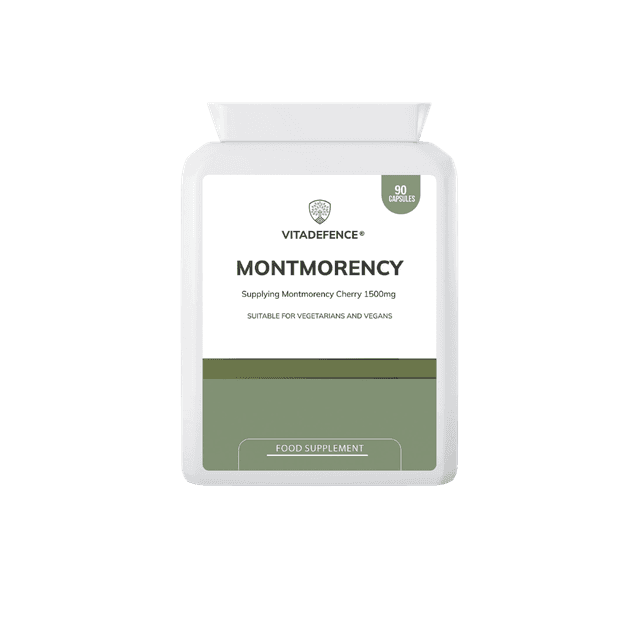
A clean vegetable cellulose capsule. Inside, 1500mg of pure Montmorency tart cherry extract — equivalent weight from a much larger amount of fresh fruit, concentrated into a single dose. No filler with strong flavours, no marketing-led co-stars. Just the cherry. One or two capsules with water in the evening — taken because you trust the evening ritual, not because you need fireworks.
Ninety capsules in a pot. At one a night, three months. At two, just over six weeks.
The story of Montmorency
Montmorency is a place before it is a cherry. The Montmorency valley sits twenty kilometres north of central Paris, the old hunting grounds of the Dukes of Montmorency, who were among the oldest noble families of France — older, in fact, than the Capetian kings they served. By the seventeenth century the valley was famous for one specific thing: a sour, ruby-red cherry that grew in the orchards along the Seine tributaries, picked in late June and early July, sold in the markets of central Paris before they could spoil, and turned into syrup, jam, brandy and pie for the rest of the year.
The cherry that bears the valley's name — Prunus cerasus, the sour cherry — is not the dark sweet cherry you eat from a bag at the supermarket. It is its older, more bitter cousin. It has been cultivated since at least Roman times (the Roman general Lucullus is supposed to have brought the first sour cherries to Italy from the Black Sea coast in the first century BC, and Pliny the Elder writes about them in his Natural History). The Montmorency variety became the standard cultivar of French confiture, of clafoutis, of the tart-cherry pie that crossed the Atlantic with French settlers and became the official state dessert of Michigan, where today around 70% of the world's tart-cherry production happens, mostly along the great-lakes coast where the cool, lake-moderated nights are exactly the climate the cultivar prefers.
What science noticed, much later, is that the same compounds that make Montmorency taste sour and stain your shirt deep red are an unusually rich source of two things. The first is anthocyanins — the dark purple pigments shared by blueberries, blackberries, elderberries and acai. Anthocyanins are polyphenols, the plant's own sunscreen against ultraviolet light, and when humans eat them, evidence suggests they may support our own internal balance against the wear-and-tear process called oxidative stress.
The second thing tart cherries contain — and this is where the evening ritual comes from — is a small natural amount of melatonin. Melatonin is the hormone your own pineal gland releases as the day darkens, telling your body that night has begun and that body temperature, blood pressure and alertness should now drop. The amount of melatonin in a Montmorency cherry is small — far smaller than a pharmaceutical melatonin tablet — but it is not zero. Together with the anthocyanin profile, it is part of why Montmorency tart cherry has become the cherry of choice for endurance runners, shift workers, and the quietly restless.
There is also a third compound family in Montmorency worth a sentence: the procyanidins and flavonols — including quercetin, which the cherry shares with onions, capers and apple skins. Quercetin is one of the most-studied plant flavonoids of the last twenty years and contributes to the broad polyphenol profile that gives the cherry its colour, its bitterness, and most of its modern reputation.
We do not promise you eight hours of sleep. We are not a sleeping aid in the pharmacological sense. What we are saying is that the cherry has earned its place — historically, traditionally, and now in a small but real body of human research — as a fruit you might choose to take in the evening, with the same intention as a chamomile tea or a hot bath: a signal to your body that the day is done.
Why it's pure, not a blend
Most supplement brands would put six other things in this bottle and call it a sleep formula. We've kept it to one. There are two reasons.
The first is dose. To get a meaningful amount of any extract, you usually have to spend most of the capsule space on it. 1500mg of Montmorency extract per capsule is a real, weighable, label-honest dose — closer to what is used in human studies than the 100mg or 200mg you'll find in many sleep blends, where the cherry is more of a flavour ingredient than a real player.
The second is patience. A pure-extract supplement lets you find out whether this one ingredient is helping you. If you take a six-ingredient sleep blend for a month and feel better, you don't know what worked. If you take pure Montmorency for a month and feel better, you know. We'd rather give you the cleaner test.
If you'd like the cherry alongside complementary partners — a magnesium for muscle relaxation, a chamomile for nervous calm, a passion flower, a lavender — that is what our Montmorency Multi bottle is for. This bottle, the one in your hand, is the cherry alone.
How to use it
One or two capsules with water, in the evening — most people take one with their evening meal or about an hour before bed. Some people prefer to take two capsules together about thirty minutes before lights-out, particularly during periods of harder training or shift-work nights, where two doses give the cherry compounds longer to do their gentle work. Do not exceed the recommended daily intake. The capsule shell is plant-derived (HPMC). The cherry does not originate from the UK; we source from established Montmorency growing regions and process to UK GMP standards.
Don't expect the kind of effect you'd get from a sleeping pill. The cherry works in the background, like a chamomile tea — gently, quietly, as part of an evening ritual that is bigger than any one ingredient. Most people who notice a difference notice it between week two and week six — not a knockout, but the small thing of falling asleep slightly faster, of dreaming with a little more colour, of waking up feeling slightly less stale, the way you used to wake up before your sleep got complicated.
If after sixty days nothing has changed, stop. A supplement that isn't doing anything for you isn't worth the money.
Honest caveats
This is a food supplement — it complements a varied diet, doesn't replace one. If you are pregnant, breastfeeding, taking medication (particularly any sedative, sleeping medication, or blood pressure medication), or living with a medical condition, talk to your GP or pharmacist first. Do not drive or operate heavy machinery if you find the cherry makes you drowsy in the early evening. Keep it cool, dry, sealed, out of reach of children.
The bottle is suitable for vegetarians and vegans (HPMC capsule, no gelatin). Although rigorous precautions are taken, this product is manufactured in a facility that handles allergy-based materials.
If you've read this far, thank you. We tried to write the kind of page we'd want to read before spending money — no neon promises, no overblown language. Just a sour cherry from a French valley north of Paris, concentrated into one capsule, and a small evening ritual that may help you let go of the day a little more easily.
— Vitadefence
— Vitadefence