Showcase
Pea Protein Multi — a yellow pea, four green companions, one daily shake
A clean plant-protein powder built around yellow pea isolate, with green tea, spirulina, açaí and dandelion. The story behind each ingredient — and what we won't promise.
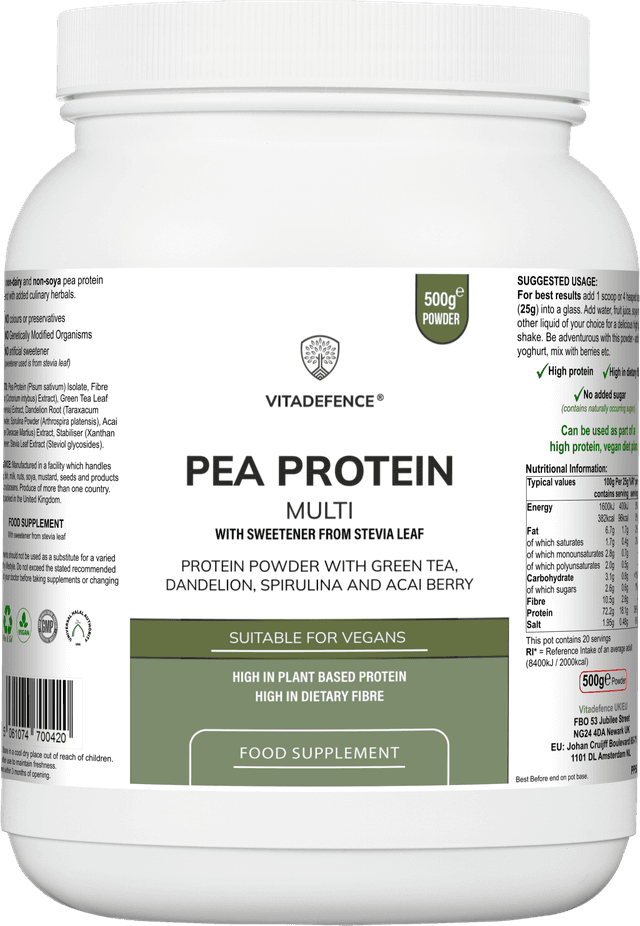
A yellow pea, four green companions, one daily shake.
If your kitchen has been quietly going dairy-free
Maybe it started with the latte. The morning oat milk, the lactose-free cheese, the protein powder that finally stopped giving you that bloated, heavy feeling. You're not vegan, necessarily. You just noticed your body is happier with fewer animal proteins in the rotation, and the gym shake is the last hold-out.
The trouble is most plant proteins taste like the cardboard tub they came in, mix to a paste at the bottom of the glass, and lean on a single isolate that misses half the amino acids you actually want from a shake. We wanted to make something cleaner — a powder you'd reach for because you liked it, not because you'd given up on the alternatives.
This little pot is one quiet answer. Yellow pea isolate as the spine, four plant companions woven through it, a touch of stevia, no artificial sweeteners, no whey, no soy. Twenty servings to a tub, twenty-five grams a serve. The kind of thing you make in thirty seconds before breakfast and forget about until your hair starts looking a little stronger and the mid-morning slump quietly stops happening.
The pot, in your hand
A clean cream tub, the green band of our label running around it like a hedgerow line. Five hundred grams of pale-green powder inside — pea protein is naturally a soft fawn-green, the colour of dried split peas left in autumn light. One scoop is twenty-five grams, four heaped teaspoons. You'll get twenty servings out of a tub.
The smell when you open it is faintly grassy, slightly sweet, no manufactured-vanilla hit. We don't add flavours. The idea is you make it your own — water, oat milk, almond milk, or pour it into a smoothie with banana and frozen berries. Adventurous days, stir it into yoghurt or porridge.
It is, deliberately, a base ingredient. Not a finished drink.
The story of the yellow pea
The pea most people picture — the bright green garden pea — is the same species, Pisum sativum, but a different cultivar. The pea we use is the yellow field pea, the dry pea grown across Canada, France, Russia and the prairies of North America. It's a winter-hardy legume that pulls nitrogen from the air and feeds it back into the soil, which is why farmers love it: a crop that improves the field it grows in.
Yellow peas have been a staple of human eating for at least nine thousand years. Carbonised pea seeds turn up in archaeological sites from Anatolia to the Nile delta. Medieval Europe ran on pottage — a thick boil-up of dried peas, cabbage, onion and whatever meat was around. Pease pudding, the workmen's lunch of industrial-revolution England, was the same idea: dried yellow peas, slowly cooked into a savoury paste, eaten with bread or ham.
What's special about the modern pea-protein process is what it leaves behind. The dried pea is milled, the starch and fibre are separated out, and what remains is a concentrated protein fraction — usually around 80 to 85% pure protein by weight, depending on the spec. The amino acid profile that emerges is rich in lysine, arginine and the branched-chain amino acids (leucine, isoleucine, valine) that get attention in resistance-training nutrition.
Where pea is naturally lower is in the sulphur-containing amino acids — methionine and cysteine. This is why the old food-pairing wisdom — beans with rice, peas with bread, lentils with grain — works on a chemistry level as well as a flavour one. Grains carry methionine; legumes carry lysine; together you get the wider amino profile your body uses to build and repair tissue. We mention it because honesty is part of the deal here: a single plant protein in isolation is not a complete amino solution. Eat your pea-protein shake on a normal mixed diet — toast, oats, rice, the occasional bit of bread — and the chemistry takes care of itself.
We use pea isolate at the spine of this formula because it carries the heaviest protein density of any pulse-derived option, mixes cleanly without a chalky finish, and digests gently for most people who struggle with whey.
Green tea — the long quiet companion
Green tea (Camellia sinensis) is the same plant as black tea — the difference is that green is steamed or pan-fired soon after picking, halting the oxidation that turns black tea dark. What survives the gentle heat is the leaf's catechin profile, especially EGCG (epigallocatechin gallate), the polyphenol most associated with green tea's reputation.
We use green tea leaf extract here at a small, supportive dose. The thinking isn't fat-burner — that's a lane we don't drive in. The thinking is that a daily shake is one of the easiest ways to get a small, consistent dose of leaf polyphenols into a Western diet that has lost most of its bitter greens. Green tea earns its place by association: it pairs naturally with the colour and the gentle astringency of the rest of the formula, and slots into the wider polyphenol family that runs through this pot.
There is a small amount of caffeine in green tea extract. If you're caffeine-sensitive, drink your shake with breakfast, not with dinner.
Spirulina — the blue-green algae older than the leaves
Spirulina (Arthrospira platensis) is not technically a plant. It's a cyanobacterium — a photosynthetic microbe that has been on Earth for somewhere between two and three billion years, oxygenating the atmosphere long before the first land plant arrived. The Aztec people of Lake Texcoco harvested it from the lake surface in dried cakes called tecuitlatl. The Kanembu people of Lake Chad still gather it as dihé, dried into thin discs and eaten with millet.
What spirulina brings to a protein shake is a wider mineral and pigment profile than pea isolate alone — chlorophyll, phycocyanin (the deep blue-green pigment), trace iron, B-vitamins. We use a small amount, not enough to dominate the colour or the flavour, but enough to add a layer of plant-mineral depth to a powder that would otherwise be a single-ingredient story.
Spirulina has its caveats. People with phenylketonuria should not consume it (it contains phenylalanine), and anyone with autoimmune conditions should mention it to their GP — the immune-modulating reputation cuts both ways. For most healthy adults, it's an old, gentle, well-tolerated food.
Açaí — the dark berry from the Brazilian river
You may have read our long account of açaí in the Acai Berry Multi showcase. The short version: it's the deep purple-black fruit of the Euterpe oleracea palm, native to the Amazon floodplain, eaten as a daily food along the rivers of Pará. What it brings to any formula is its pigment density — the anthocyanins that give the fruit its colour and its reputation in the wider polyphenol family.
In a protein powder, açaí is a colour signature more than a dose. A small amount of extract sits in this pot to lend the formula its association with the wider dark-berry tradition: the idea that the colour you eat is part of how the plant earns its place in your week.
Dandelion root — the bitter green from the kitchen-garden lawn
Dandelion (Taraxacum officinale) is one of those plants almost everyone knows by sight and almost nobody eats. The yellow flower, the seed clock, the deeply lobed leaf. In medieval European herbal tradition it was piss-en-lit — the French nickname for what dandelion has historically been credited with as a gentle digestive bitter. Roasted dandelion root has been a coffee substitute since at least the eighteenth century, particularly in wartime Europe when real coffee was rationed or unavailable.
What dandelion brings to a daily shake is bitterness — the digestive cue that disappeared from Western diets sometime around the rise of supermarket convenience food. Bitter is a flavour the gut listens to: it gently signals the digestive system to wake up. We use it here in a small dose, partly for its place in traditional digestive lore, partly because it adds another layer of plant variety to a formula built around the idea of colour and depth.
The chicory fibre and the stevia leaf
Two more ingredients deserve a sentence each.
Chicory root extract (Cichorium intybus) is the source of inulin, a soluble plant fibre that feeds the friendly bacteria in the large intestine. We use it here partly to add body to the shake — pea isolate alone is a thin-mouthfeel powder — and partly because most Western diets are short on the kind of soluble fibre that wakes up the gut microbiome.
Stevia leaf extract (Stevia rebaudiana) is the gentle sweetener. Stevia is a plant from Paraguay, used by the Guaraní people for centuries to sweeten yerba maté. We use it sparingly — enough to round the edge off the pea, not enough to dominate. There is no sucrose, no aspartame, no sucralose in this pot.
The formula as a whole
Lay the seven ingredients on the table — yellow pea, chicory root, green tea, dandelion, spirulina, açaí, stevia — and what they share is plant-density and gentle handling. None of them is a stimulant. None of them is a megadose. The pea does the protein work; the other six widen the picture, add the missing colours and bitters that a single-ingredient powder would lack.
The thinking isn't whey-replacement. Whey is a different food, with a different amino profile, a faster absorption curve, a louder leucine spike. Pea-protein is a quieter, gentler shake that suits people whose stomachs prefer plants, whose ethics lean dairy-free, or whose diet just runs cleaner without animal-source isolates in it.
How to use it
One scoop, one to three times a day. Twenty-five grams adds about twenty grams of protein to your day, depending on the batch's exact spec. Most people use one scoop in a morning shake — water or oat milk, a banana, a handful of berries, ice if you like it cold. Some people add it to porridge or yoghurt. Adventurous days, stir it into a soup or a savoury sauce — pea protein is naturally savoury, and disappears quietly into anything tomato-based.
Don't expect the shake to do all your protein work for you. A varied plate — pulses, grains, leafy greens, whatever animal foods you do eat — is still where most of your nutrition comes from. The shake is one easy, repeatable cup of plant protein on a busy morning, not a meal replacement.
If you've been training and chasing protein targets, pair the shake with a grain meal — rice, oats, bread, pasta — and you'll cover the wider amino profile in a way pea-alone wouldn't. This is the old food wisdom doing its job in a modern shaker bottle.
Honest caveats
This is a food supplement — a daily-life product, not a medical one. It complements a varied diet, it doesn't replace one. If you are pregnant, breastfeeding, taking medication, or living with a medical condition, talk to your GP or pharmacist before starting. People with phenylketonuria should avoid this product because of the spirulina content. If you are caffeine-sensitive, take it earlier in the day rather than late evening — the green tea extract carries a small amount.
Keep the pot cool, dry, sealed, out of reach of children. Use within the best-before date. The pea is sourced from established field-pea supply chains, and the formula is blended to UK GMP standards.
If you've read this far, thank you. We tried to write the kind of page we'd want to read before spending money — no fat-burner promises, no muscle-gain shouting, no cynical plant-based-superfood labels. Just a yellow pea, four green companions, a touch of leaf-sweetness, and a daily shake that may help you feel a little cleaner in the morning.
— Vitadefence
— Vitadefence