10 Reasons People Take Spirulina (and What the Evidence Actually Says)
Spirulina has been called the most nutrient-dense food on earth. Marketing aside, the actual reasons people add it to their daily routine are real and well-documented. Here are ten of them, with the evidence behind each one and the honest caveats.
By Vitadefence Editorial
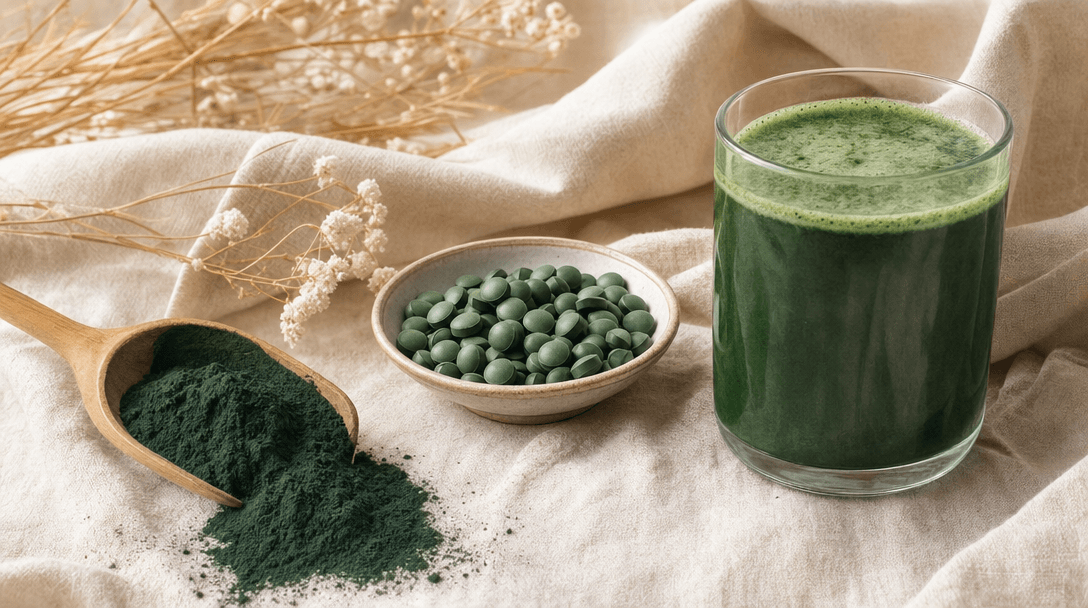
Spirulina has had more marketing attention than almost any single supplement ingredient on the planet. Some of it is well earned — this is genuinely one of the most nutrient-dense foods documented in human nutrition. Some of it is overblown. The honest version is more interesting than either extreme: it is a tiny blue-green photosynthetic organism that, gram for gram, packs more protein, B vitamins, iron, and antioxidant pigment than any common food crop.
Here are ten of the actual reasons people add it to their daily routine, what the research supports for each, and the caveats worth knowing.
Why this matters before you buy a bottle
Most people start looking at spirulina because they hit one of three life-stage moments: they go vegan or plant-based and start worrying about B12 and iron, they get into harder training and want a clean protein source, or they read enough nutrition content to want a single nutrient-dense addition to their morning routine. All three are reasonable starting points. Spirulina is unusual because it slots into all of them.
What spirulina actually is
Spirulina (Arthrospira platensis) is a cyanobacterium — a microscopic, spiral-shaped, blue-green photosynthetic organism that has lived in alkaline freshwater lakes for billions of years. It is not strictly a plant or an alga, but for nutritional purposes it behaves like one. NASA assessed it in the 1970s as a candidate astronaut food because the nutrient density per gram is remarkable. Today it is grown in controlled aquaculture pools, harvested, dried, and sold either as powder or in capsule form.
The ten reasons people take it
1. One of the densest single-ingredient protein sources in the plant world
Dry spirulina is roughly 60–70% protein by weight, with a complete amino acid profile (all nine essential amino acids present). For comparison, dried beef is roughly 26% protein, dried lentils about 25%, and most plant proteins under 30%. Practical amount-per-serving is small (typical 3–5 g daily dose delivers around 2–3 g protein) — so it is not a primary protein source, but it is exceptionally dense for what it is.
2. A rare plant source of vitamin B12-related compounds
This is the most contested claim in the spirulina literature. Spirulina contains compounds that test as B12 in some assays, but a portion of these are pseudo-B12 (cobamides) that may not be biologically active for humans. Research is ongoing. Honest position: spirulina is not a reliable replacement for B12 supplementation in vegans, but it does provide some bioavailable B12-related activity. EFSA has not authorised a specific B12 health claim for spirulina, and the conservative recommendation for plant-based eaters is to take a dedicated B12 supplement alongside.
3. Plant iron in a more bioavailable form than most
Spirulina contains roughly 28 mg of iron per 100 g of dry weight — meaningful, though typical 3–5 g servings deliver around 1 mg. The iron in spirulina has been shown in human studies to absorb better than iron from many vegetable sources, possibly due to the surrounding pigment-protein matrix. Useful as a contributor to overall iron intake, particularly for plant-based eaters.
4. Phycocyanin — the blue pigment that does the work
Phycocyanin is the pigment that gives spirulina its distinctive blue-green colour, and it is one of the most-studied single compounds in the algae literature. EFSA authorises iron under EU Reg 1924/2006 for "contribution to protection of cells from oxidative stress." Phycocyanin itself does not yet have an authorised health claim, but the laboratory evidence on its antioxidant activity is consistent across multiple studies. Worth knowing this is what you are paying for visually — the deeper the blue-green, the more phycocyanin in the powder.
5. Beta-carotene and other carotenoids
Spirulina is one of the highest plant sources of beta-carotene by weight, alongside zeaxanthin and other carotenoids. These convert to vitamin A in the body and contribute to "maintenance of normal vision" and "maintenance of normal skin" under EFSA's authorised claims for vitamin A.
6. B-vitamin complex
Spirulina contains thiamine (B1), riboflavin (B2), niacin (B3), and pantothenic acid (B5) in meaningful amounts. EFSA has authorised claims for each of these around energy metabolism — for example, B1 contributes to "normal energy-yielding metabolism" and B2 to the "reduction of tiredness and fatigue." Spirulina is a partial contributor to daily B-vitamin intake, not a complete replacement for a full B-complex.
7. Magnesium, calcium, potassium, and other minerals
Trace minerals are present in modest amounts. Not a primary source, but contributes to overall daily mineral intake — particularly relevant for plant-based eaters who may run lower on certain minerals.
8. Chlorophyll content
Spirulina is rich in chlorophyll, the green pigment plants use for photosynthesis. The popular "detox" claims around chlorophyll are not supported by EFSA-authorised health claims. The honest framing: chlorophyll is a structural antioxidant compound, and spirulina is one of the densest plant sources of it. Whether that translates into clinical benefit beyond general antioxidant support is still being researched.
9. Studied in athletic recovery contexts
A small body of research (Kalafati et al., 2010, Medicine & Science in Sports & Exercise; Lu et al., 2006) has looked at spirulina supplementation in athletic populations and found associations with reduced markers of exercise-induced muscle damage and oxidative stress. The studies are small and the effect sizes vary, so this is not a settled finding — but it is a coherent area of ongoing research.
10. Convenience as a daily green
The most underrated reason: a spirulina capsule or scoop of powder gets a chunk of plant-derived nutrition into a routine that might otherwise lean heavily on processed foods. It is not a substitute for actual vegetables, but for someone whose daily green-vegetable intake is genuinely low, it is a practical floor.
Honest caveats
Spirulina is not magic. A few things worth knowing:
- Source matters enormously. Spirulina is grown in water, and water-borne contaminants (heavy metals, microcystins from contaminating blue-green algae species) are a real concern with cheap, poorly-controlled production. Choose a manufacturer that publishes contaminant testing.
- Sulphites. Spirulina contains naturally occurring sulphites, which can affect a small number of sensitive individuals. The Vitadefence label flags this clearly.
- People with phenylketonuria (PKU) should avoid spirulina because of its phenylalanine content.
- Autoimmune conditions. Some sources suggest people with autoimmune conditions consult a healthcare professional before starting, due to spirulina's modest immune-modulating activity. Conservative position.
- Pregnancy and breastfeeding. Always consult a healthcare professional first.
How to use it
The standard daily intake is around 1–3 g (1–6 capsules of typical 500 mg strength), taken with food. Some people prefer it in powder form blended into a morning smoothie. The taste of pure spirulina is pond-water-adjacent, which is why most people who use the powder mix it with fruit. Capsules are more practical for daily consistency.
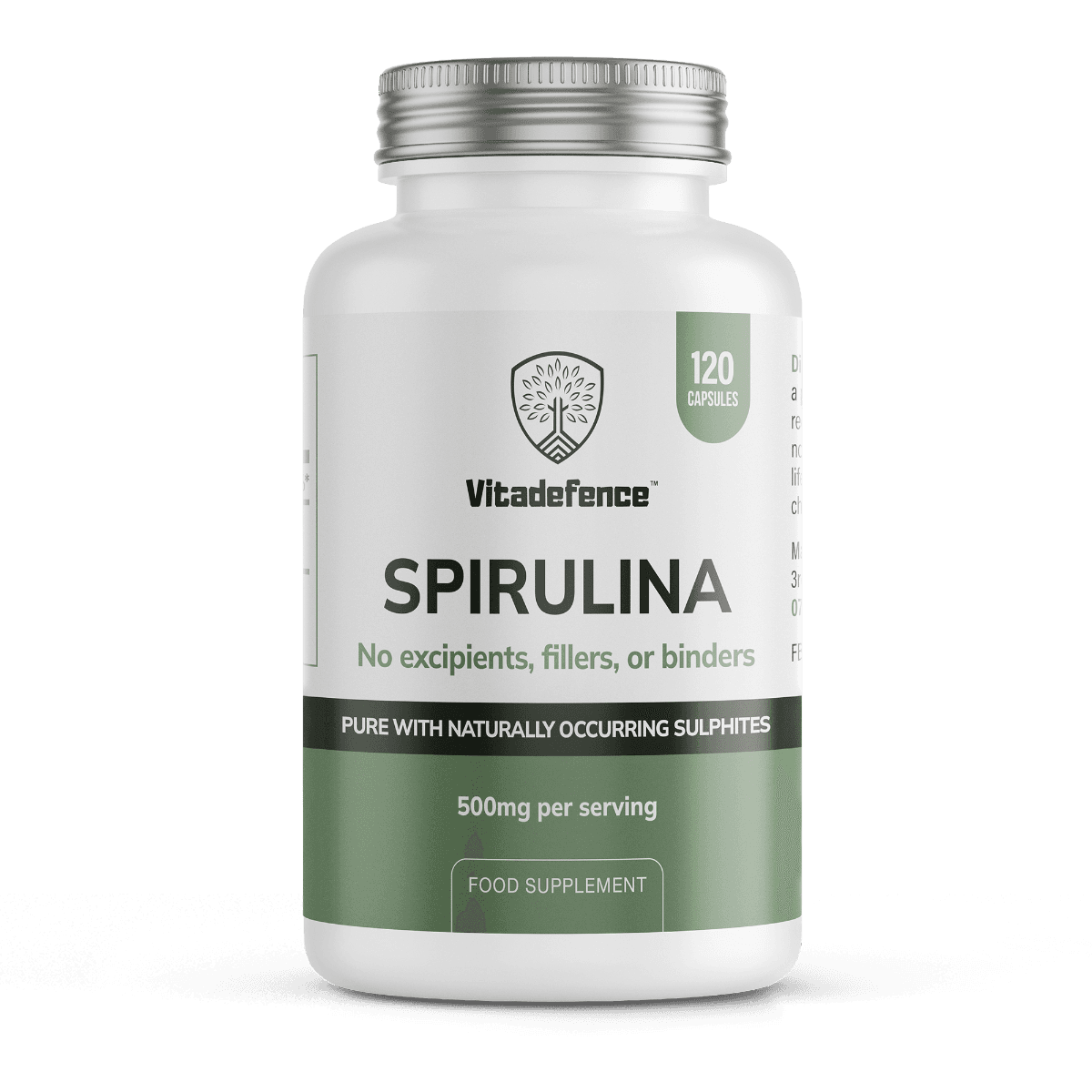
At Vitadefence, the Spirulina capsules are 500 mg vegan capsules from non-GMO algae sources, manufactured in a UK GMP-certified facility. The full ingredient breakdown and allergen information is on the product page. For a broader daily nutrient base, the Vitamins Multi formula covers the full vitamin and mineral spectrum alongside live bacteria and herbal extracts.
The takeaway
Spirulina is genuinely one of the most nutrient-dense single foods available. It is not a magic powder, and the most overblown marketing claims (B12 replacement, detox, dramatic weight loss) are not supported by the evidence. What it does well — concentrated protein, plant iron, phycocyanin, carotenoids, B-vitamin contribution — it does well enough to justify a place in a daily routine, particularly for plant-based eaters and people who train hard. Pick a clean source, take it consistently, and treat it as a daily nutritional contribution rather than a cure-all.
This article is for informational purposes only and does not constitute medical advice. Vitadefence supplements are food supplements, not medicines, and should not be used as a substitute for a varied diet and a healthy lifestyle. Consult a healthcare professional if you are pregnant, breastfeeding, on medication, or have a medical condition.
Related products
More from the journal
Spirulina: The Original Superfood — Protein, B12, and Phycocyanin Antioxidant Power
9 min · Ingredients
Siberian Ginseng Benefits: Why This Adaptogen Is Different From Panax Ginseng
7 min · Ingredients