Collagen Supplements: Do They Really Work? What the Science Says
Collagen supplements show real results for skin, joints, and bones according to clinical research. Learn about marine vs. bovine, optimal dosing, and how to boost absorption.
By Vitadefence Team
Collagen supplements have exploded in popularity, with claims ranging from smoother skin to stronger joints. But do they actually deliver on these promises? Let's look at what the research says.
What Is Collagen?
Collagen is the most abundant protein in your body, making up about 30% of total protein content. It provides structure to your skin, bones, tendons, ligaments, and cartilage. Think of it as the scaffolding that holds your body together.
Your body naturally produces collagen, but production declines by roughly 1% per year after age 25. By age 60, collagen production has typically dropped by more than 50%.
Types of Collagen
- Type I: Found in skin, bones, and tendons. Makes up 90% of your body's collagen.
- Type II: Found in cartilage. Important for joint health.
- Type III: Found in skin, blood vessels, and organs. Often found alongside Type I.
What Does the Research Show?
Skin health: A 2019 systematic review of 11 studies involving over 800 patients found that collagen supplementation significantly improved skin hydration, elasticity, and wrinkle depth compared to placebo. Most studies used 2.5-10 grams per day for 8-12 weeks.
Joint health: A study in Current Medical Research and Opinion found that athletes taking collagen hydrolysate experienced significantly less joint pain during activity compared to placebo. Type II collagen has been particularly studied for osteoarthritis.
Bone density: A 12-month study found that postmenopausal women taking 5 grams of collagen peptides daily showed increased bone mineral density compared to control groups.
Marine Collagen vs. Bovine Collagen
Marine collagen (sourced from fish) is primarily Type I and is known for its superior bioavailability — the peptides are smaller and more easily absorbed. Bovine collagen (from cows) typically contains Types I and III. Both are effective, but marine collagen may be preferred for skin-focused benefits.
How to Maximise Absorption
Take collagen with vitamin C, which is essential for collagen synthesis. Taking it on an empty stomach may improve absorption. Hydrolysed collagen (collagen peptides) is already broken down into smaller pieces, making it easier for your body to use.
How to Choose a Quality Collagen Supplement
With the collagen market booming, knowing what to look for is essential:
- Hydrolysed collagen peptides: Look for "hydrolysed" or "peptides" on the label. This means the collagen has been broken down into smaller molecules (typically 2–5 kDa) that your body can absorb far more efficiently than whole collagen.
- Type matters: For skin benefits, look for Type I collagen (marine collagen is primarily Type I). For joint support, Type II collagen (often from chicken sternum) is most studied. Many supplements combine Types I, II, and III for comprehensive coverage.
- Source quality: Marine collagen should ideally come from wild-caught fish. Bovine collagen should be from grass-fed, pasture-raised cattle. Check that the source is clearly stated on the label.
- Added vitamin C: Since vitamin C is essential for your body to synthesise its own collagen, a supplement that includes it provides both the building blocks and the catalyst. This is a sign of a well-formulated product.
- Minimal additives: Avoid products with excessive sweeteners, artificial flavours, or unnecessary fillers. Capsule forms tend to be cleaner than flavoured powders.
Who Should Consider Collagen Supplementation?
Collagen supplementation may be particularly beneficial for:
- Adults over 30 — collagen production declines by roughly 1% per year from age 25
- Anyone noticing increased skin dryness, fine lines, or loss of elasticity
- Active individuals and athletes experiencing joint stiffness or discomfort
- People recovering from tendon or ligament injuries
- Postmenopausal women, as declining oestrogen accelerates collagen loss
- Those with brittle nails or thinning hair
- Anyone who has had significant sun exposure over their lifetime
Daily Tips for Maximising Collagen Benefits
Take collagen on an empty stomach or between meals for best absorption — though taking it with vitamin C-rich food (like a glass of orange juice) can boost collagen synthesis. Consistency is crucial: most studies showing visible skin improvements used 8–12 weeks of daily supplementation. Protect existing collagen by wearing SPF daily (UV radiation is the number one cause of collagen breakdown in skin), staying hydrated, limiting sugar intake (sugar cross-links and damages collagen fibres), and not smoking. A 5–10 gram daily dose is typical for skin and joint benefits. Collagen peptides are virtually tasteless in capsule form, making them easy to incorporate into your routine.
Recommended for You

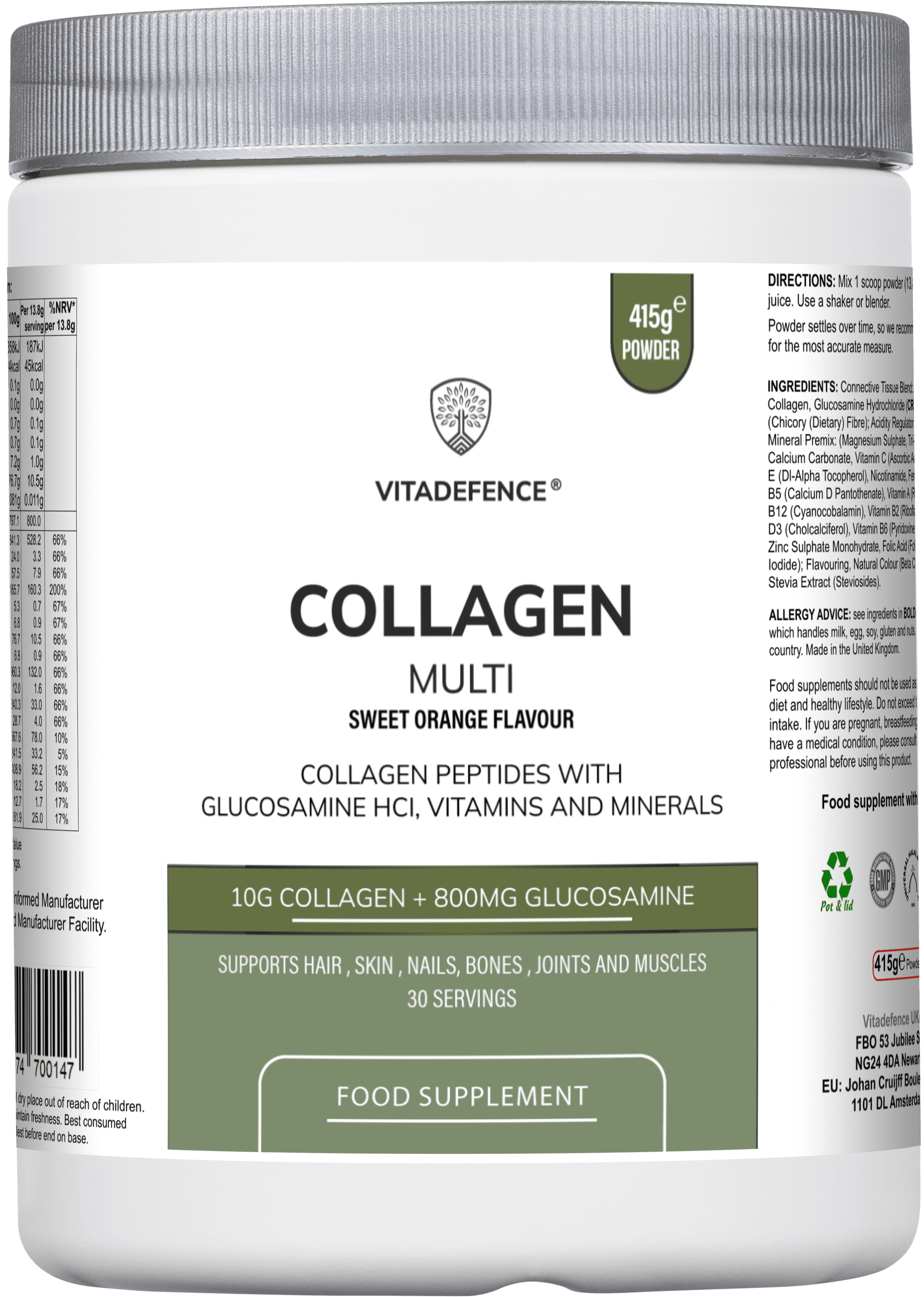
Collagen Multi | Orange Flavour Powder with Glucosamine, Vitamins & Minerals – 415 g
£27.49
Shop NowThis article is for informational purposes only and does not constitute medical advice. Vitadefence supplements are food supplements, not medicines. They should not be used as a substitute for a varied diet and a healthy lifestyle. Consult a healthcare professional if you are pregnant, breastfeeding, on medication, or have a medical condition.
Related products
More from the journal
Spirulina: The Original Superfood — Protein, B12, and Phycocyanin Antioxidant Power
9 min · Ingredients
Siberian Ginseng Benefits: Why This Adaptogen Is Different From Panax Ginseng
7 min · Ingredients