FREE Royal Mail · 2–3 daysGMP quality standardsMade in the UKVAT included
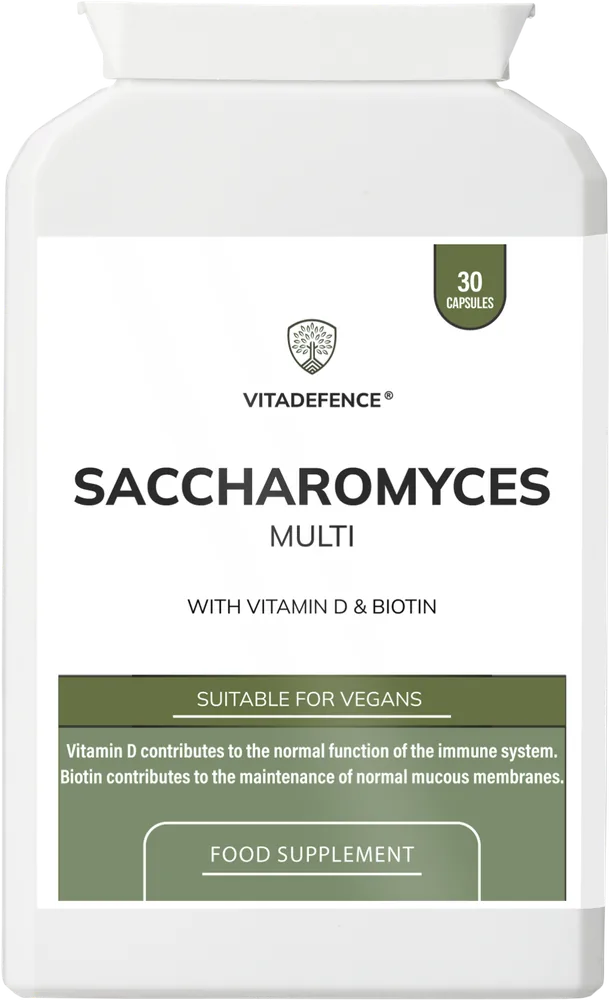
Live cultures & enzymes · 100% Plant-based · Vegan · With Vitamin D3, Biotin, Olive Leaf & Bamboo Silica · 30 Capsules
| Biotin | 8µg | 16% |
| Vitamin D (D3) | 2.50µg (100iu) | 50% |
| Saccharomyces Boulardii | 5 billion CFU |
| Olive Leaf** (providing 2.00mg of Oleuropein) | 200mg |
| Bamboo silica** | 10mg |
Saccharomyces Boulardii, Stoneground Brown Rice Flour (Oryza Sativa), Capsule Shell: Hydroxypropyl Methylcellulose (HPMC), Bamboo Silica Extract (Bambusa Vulgaris), Olive Leaf Extract (Olea Europaea), Vitamin D3 (Cholecalciferol) (Vegan), Biotin.
Take 1 capsule, 1 to 3 times per day before meals or as advised. Up to 6 capsules per day. This product is stable at room temperature, but may be refrigerated to preserve freshness. NOTE: Included in each pot is a small food grade approved sachet to ensure the product remains unaffected by moisture after it is opened for use. As stated on the sachet, this is not to be eaten.
Store in a cool, dry place, out of reach of children. Do not use if the seal is damaged. Best before date printed on the base.
Suitable for vegetarians and vegans · Kosher approved · Halal approved
Looking for Saccharomyces boulardii? Here is ours: Saccharomyces Multi (With Vitamin D3, Biotin, Olive Leaf & Bamboo Silica, 30 Capsules), made in the UK.
Most of what you read about probiotics is about bacteria. Lactobacillus this, Bifidobacterium that, multi-strain blends in cold-chain pots. But there is another quiet citizen in the gut-health story — a friendly yeast — and it sits at a slightly different table.
Maybe a doctor or a pharmacist mentioned S. boulardii and you went home and looked it up and ended up here.
This little 30-capsule pot is built around a single yeast strain — Saccharomyces boulardii — paired with olive leaf, a bit of vitamin D3, biotin, and bamboo silica. It is not a replacement for the bacterial probiotic you might already be taking. It sits alongside it.
A small white pot, thirty vegan capsules inside, the seal closed snugly with a tiny food-grade desiccant sachet to keep moisture out. The dose is gentle — one capsule, one to three times a day, before meals — taken with water. The whole pot lasts ten days at the higher dose, a month at the gentlest.
It does not need refrigeration. S. boulardii is unusually stable at room temperature compared with the bacterial probiotics in your fridge — one of the quiet practical advantages of the strain. Store in a cool, dry place.
In 1923, a French microbiologist called Henri Boulard was working in Indochina during a cholera outbreak. In 1923 Henri Boulard isolated the yeast from lychee and mangosteen skins. He cultured what was on the skins and isolated a single yeast — a relative of brewer's yeast and baker's yeast, but distinct, with a temperature preference of 37°C (body temperature) rather than 30°C (kitchen temperature).
He named it after himself.
For most of the twentieth century, S. By the 1990s the rest of the world had caught up: Germany, Spain, Italy, Latin America, parts of Asia all carry it on pharmacy shelves under one trade name or another.
What makes this yeast different from a bacterial probiotic is that it is not bacteria. Antibiotics — which are designed to kill bacteria — don't kill it.
It also doesn't take up permanent residence. S. boulardii is a transient — it passes through over the course of a few days after you stop taking it, leaving the gut to its own bacterial communities. That transient quality is, again, a feature rather than a bug. It is a guest, not a resident.
5 billion CFU per capsule.
If the headline of this pot is the yeast, the closest companion is the olive. Olive leaf has been used in Mediterranean folk medicine since at least the time of the Pharaohs — the ancient Egyptians wrapped mummies in olive leaves, and the leaf shows up in Crete, Cyprus, and across the Levantine coast as a fevers-and-stomach plant for two thousand years.
The active fraction modern chemistry has paid most attention to is a bitter compound called oleuropein — the same compound that gives olive oil its peppery back-of-throat finish. We use 200mg of olive leaf extract standardised to 2.00mg of oleuropein per capsule.
Olive leaf earned its place here for the same reason it earned its place in Mediterranean kitchens: it is a quietly sturdy plant whose tradition runs alongside the modern story rather than competing with it.
The pairing of yeast and olive leaf is not random. The Mediterranean coast where S. boulardii was first refined into pharmacy form is the same coast where olive leaf tea has been brewed for stomach upsets for centuries. We are not claiming a clinical synergy. We are noting a geographical one — two ingredients that grew up in the same kitchen, kept the same company for a long time, and earn a daily seat together for that reason alone.
Vitamin D3 is in this pot at a modest 2.50µg (100 IU, 50% NRV) per capsule. It is not the headline. Vitamin D contributes to the normal function of the immune system.
If you are already taking a higher-strength D3 supplement, this small dose simply adds to it. If you are not, it is a soft daily contribution rather than a corrective one. Take with a meal that contains some fat — D3 is fat-soluble, so a piece of toast with butter, a meal with olive oil, or a fatty breakfast all help absorption.
Biotin (vitamin B7) sits at 8µg per capsule (16% NRV). Biotin contributes to the maintenance of normal mucous membranes. Its presence here is small but thematically appropriate.
Bamboo silica, at 10mg per capsule, is a plant-derived source of silicon, a trace mineral that is part of connective tissue. It is here as a quiet seat-of-table ingredient — a tradition more than a strong claim — and rounds out the formula without overcrowding it.
One capsule, one to three times a day, before meals, with water. Take with the first meal of the day if you are using it as a daily one-capsule habit. Take 1 capsule, 1 to 3 times a day before meals, up to 6 a day.
If you are taking antibiotics, S. boulardii can be taken at the same time as the antibiotic — it is unaffected by the drug. You don't need to space it apart the way you would with a bacterial probiotic.
The pot fits in hand luggage and tolerates the cabin temperature without complaint.
Like most things in this cupboard, S. boulardii either earns its place quickly or doesn't earn it at all.
This is a food supplement and not a medicine. It complements a varied diet, it doesn't replace one, and it does not replace medical care. If your stomach trouble is severe, persistent, bloody, or accompanied by fever or weight loss, that is a GP visit, not a capsule.
If you are immunocompromised — chemotherapy, organ transplant, HIV, severe immune deficiency — speak to your specialist before taking any live yeast supplement. Cases of S. boulardii fungaemia have been reported, very rarely, in patients with central venous catheters or severely weakened immunity. The risk in healthy adults is essentially zero, but for the small group above it is not, and that group should take medical advice first.
If you have a known yeast allergy, this is not the supplement for you — try a bacterial probiotic instead.
This pot is not a treatment. We don't claim it does. It complements a balanced lifestyle.
Keep it cool, dry, sealed, out of reach of children.
— Vitadefence


