Showcase
Chlorella vs Spirulina: What's the Difference, in Plain English
Two green powders, often shelved side by side, frequently confused. One is a true algae with a tough cell wall; one is a cyanobacterium the Aztecs scooped off a lake. Here's the honest difference.
Chlorella and spirulina turn up next to each other on the shelf, both deep green, both sold as powders and tablets, and they are very easily muddled. The simplest way to keep them apart: spirulina is a cyanobacterium (a blue-green organism), while chlorella is a true single-celled green algae with a tough cell wall. From that one difference, most of the rest follows.
Where each one comes from
Spirulina has the older human story. It grew in the alkaline lakes of the Valley of Mexico and around Lake Chad, and was harvested as food long before anyone had a microscope — the Aztecs skimmed it off Lake Texcoco and dried it into cakes called tecuitlatl. It is, technically, one of the oldest life-forms on earth.
Chlorella is a more modern arrival. It was identified in the late nineteenth century and seriously cultivated only after the Second World War, especially in Japan and Taiwan, where it remains hugely popular today. Because chlorella has that hard cell wall, modern producers "crack" it (mechanically break the wall) so the nutrients inside are easier to get at — you will often see "broken cell wall" or "cracked cell wall" on a good chlorella label.
The nutritional difference
Both are unusually protein-dense for a plant food — spirulina is famously around 60% protein by dry weight. Spirulina also carries the blue pigment phycocyanin, which is what gives a good spirulina its slightly blue-green cast. Chlorella leans green because it is rich in chlorophyll, and it brings a different fibre profile thanks to that cell wall.
Within the rules, what we will say is this: both are whole-food sources of plant protein and a spread of micronutrients, and protein contributes to the growth and maintenance of normal muscle mass. We will not claim either one detoxifies you, cleanses you, or treats a condition — those claims are not authorised, and we would rather be the brand that tells you so.
Taste, form, and how to choose
Honestly? Both taste of the pond they came from — green, mineral, a little marine. Most people take them as tablets to skip the flavour, or hide the powder in a strong smoothie with banana and cocoa. As a rough rule of thumb: people reach for spirulina for its high protein and its long pedigree, and for chlorella for its chlorophyll and fibre. There is no winner — they are different foods doing different things, and some people simply alternate.
The bottle, in your hand
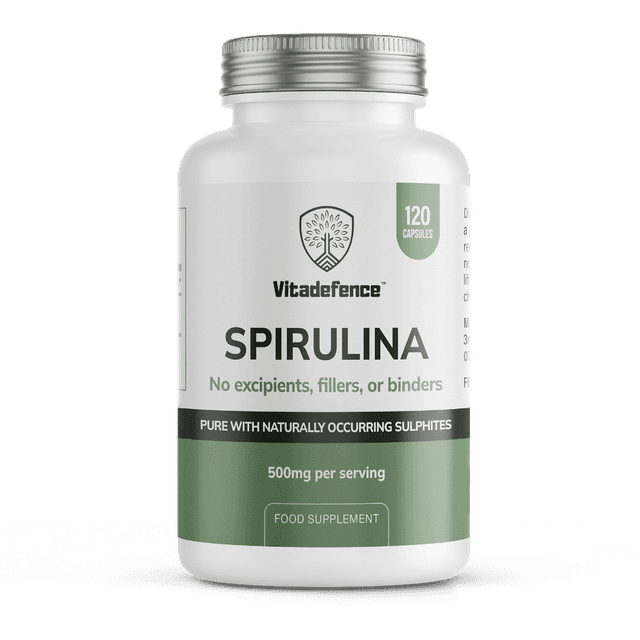
Our spirulina is the dried, pressed algae, capsuled with nothing it does not need. It is a food supplement, a complement to a varied diet rather than a replacement. Start with the label dose, with water, with a meal.
Honest caveats
Algae products should come from a clean, tested source — algae take up whatever is in their water, so quality control matters more here than almost anywhere. If you have an auto-immune condition, or you are on blood-thinning medication, or you are pregnant or breastfeeding, check with your doctor first. People with the rare metabolic condition PKU should note that, like any high-protein food, these contain phenylalanine.
If you have read this far, thank you. Two ancient green foods, one a bacterium and one an algae, told straight.
— Vitadefence
Related articles
— Vitadefence