Showcase
What Is Moringa? The Drumstick Tree, From Himalayan Foothill to Daily Capsule
Moringa oleifera — the 'drumstick tree' of the Himalayan foothills, whose leaf is one of the most nutrient-dense greens in the kitchen. The story, the facts, and how we put it in a capsule.
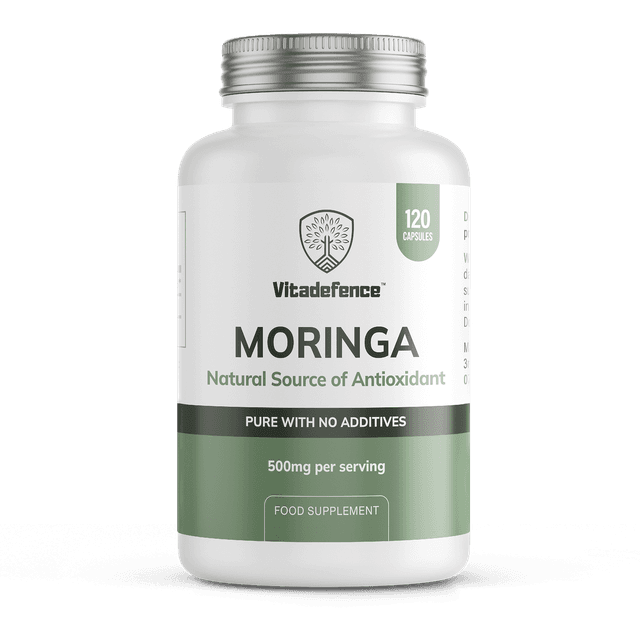
If you have come here typing what is moringa into a search box, here is the short answer: moringa is the dried leaf of Moringa oleifera, a fast-growing tree native to the foothills of the Himalayas and now cultivated across the tropics. It is sometimes called the "drumstick tree" for its long seed pods, and the "tree of life" for how much nutrition sits in its small leaves. The longer answer is a nicer story.
The tree itself
Moringa is one of the fastest-growing trees in the world — it can put on several metres in a single year, which is part of why it has fed people in dry, difficult climates for centuries. Nearly every part is used: the young pods are cooked like green beans across South India, the flowers go into omelettes, the seeds press into an oil, and the leaves are dried and ground into the bright green powder you will recognise from health-food shelves.
Why people call it nutrient-dense
Dried moringa leaf is, gram for gram, a genuinely concentrated food. According to standard food-composition data it provides plant protein with a broad amino-acid profile, along with a spread of vitamins and minerals including vitamin A, vitamin C, calcium, potassium and iron. That is simply what is in the leaf — it is a leafy green that happens to be unusually dense, the way kale or spinach are dense, rather than anything exotic.
We are careful here, because the law is careful: we are not going to tell you moringa treats or cures anything. What we can say, plainly and within the rules, is that the nutrients naturally present in a varied diet do real work — for example, vitamin C contributes to normal immune function and to the reduction of tiredness and fatigue, and iron contributes to normal red blood cell formation. Moringa is one pleasant, plant-based way to add a little of that colour back into a week of beige lunches.
The long human history
Moringa has been in the kitchen and the apothecary of the Indian subcontinent for a very long time — it appears in Ayurvedic texts and in everyday Tamil and Bengali cooking alike. Traders carried it across to the Philippines, to East Africa, to the Caribbean, where it settled into local cuisines under a dozen names: malunggay, sajna, benzolive. It earned the "tree of life" nickname honestly: in places where the dry season is hard, a tree that grows fast and feeds a family is exactly that.
The bottle, in your hand
Our moringa is the dried leaf, capsuled, with nothing else it does not need. Take it with a meal, with a glass of water. It is a food supplement — it complements a varied diet, it does not replace one. Think of it as a small, green, daily habit rather than a medicine.
Honest caveats
If you are pregnant or breastfeeding, talk to your GP before adding any new supplement — moringa root and bark are traditionally avoided in pregnancy, and while we use leaf only, the cautious path is to ask first. If you are on medication, particularly for blood sugar or blood pressure, mention it to your doctor. And if your diet is already full of fresh greens, you may not need it at all — we would always rather tell you that than sell you something you do not.
If you have read this far, thank you. We wrote the kind of page we would want to read before spending money: just a remarkably useful tree, a leaf full of good things, and a small daily ritual.
— Vitadefence
Related articles
— Vitadefence