Eleutheroside Chemistry Explained: What B and E Actually Are
If you have read 'standardised to 0.8% eleutherosides B+E' on a label and wondered what that actually means, this article walks through the chemistry, the analytical methods, and why standardisation exists at all.
By Vitadefence Team

Standardisation is the difference between a botanical extract and a botanical lottery. For Eleutherococcus senticosus, the European Pharmacopoeia uses two compounds — eleutheroside B and eleutheroside E — as the marker analytes. A label that reads 'standardised to 0.8% eleutherosides B+E' is making a measurable, verifiable, lab-testable claim. Here is what those compounds are and why they were chosen.
What is a marker compound?
A marker compound is a measurable chemical entity in a complex botanical extract that is used as a quality-control reference. It does not have to be the active ingredient — it is the chemical fingerprint that lets a lab confirm the identity, batch consistency, and concentration of an extract. For ginkgo it is the flavone glycosides and terpene lactones. For St John's Wort it is hyperforin and hypericin. For Eleutherococcus, the European Pharmacopoeia chose eleutherosides B and E.
Eleutheroside B (syringin)
Eleutheroside B is a phenylpropanoid glycoside. Chemically it is syringin — the 4-O-β-D-glucopyranoside of sinapyl alcohol. Molecular formula C17H24O9, molar mass 372.37 g/mol. Syringin occurs naturally in many plants in the family Araliaceae and Oleaceae; in Eleutherococcus root it is one of the most abundant phenolic glycosides.
Why this compound and not another? Three reasons: it is reliably present in authenticated E. senticosus root material, it is chemically stable through standard extraction and drying, and it can be quantified by HPLC with UV detection at common wavelengths (around 265 nm).
Eleutheroside E (syringaresinol diglucoside)
Eleutheroside E is a lignan glycoside — specifically the di-β-D-glucopyranoside of (+)-syringaresinol. Molecular formula C34H46O18, molar mass 742.72 g/mol. Lignans are dimers of two phenylpropanoid units, and the syringaresinol scaffold is shared with several other plant lignans.
Eleutheroside E is the more characteristic of the two markers — it is found in higher concentration in authenticated Eleutherococcus root than in most adulterant species, which makes it useful for both standardisation and authenticity testing.
Why two markers, not one?
Using two structurally distinct compounds (a phenylpropanoid glycoside and a lignan glycoside) as markers makes adulteration harder and authentication more robust. A counterfeit extract that mimics one marker is unlikely to mimic the second at the right ratio. Quality-control labs typically run a chromatogram and check both peaks against reference standards.
What 0.8% means on a label
'Standardised to 0.8% eleutherosides B+E' means that the extract powder, by mass, contains at least 0.8% of the combined mass of eleutheroside B + eleutheroside E. So 100 mg of extract delivers at least 0.8 mg of these two markers combined. The 0.8% figure is the threshold typical of European Pharmacopoeia-aligned ingredient suppliers.
For a 400 mg capsule of standardised Eleutherococcus extract, that translates to at least 3.2 mg of combined eleutherosides B+E per capsule. That is a verifiable specification, not a marketing number.
The analytical method
The European Pharmacopoeia method for Eleutherococcus uses HPLC with a C18 reversed-phase column, a water/acetonitrile gradient with a small percentage of phosphoric acid for peak shape, and UV detection at 220 and 265 nm. Eleutheroside B elutes early; eleutheroside E elutes later because it is more lipophilic. The peaks are integrated and the concentrations calculated against external standards.
Each batch of extract used in a finished supplement should have a Certificate of Analysis (CoA) showing the eleutheroside content. Reputable manufacturers retain CoAs for traceability and can produce them on request.
What standardisation does NOT tell you
Standardisation guarantees a measurable level of the marker. It does not by itself guarantee:
- The correct extraction ratio (DER) — this should be stated separately
- The full phytochemical fingerprint matches authenticated material — that requires HPTLC or full chromatographic comparison
- Heavy-metal, microbiological, or pesticide compliance — these are separate Pharmacopoeia tests
- Solvent residue limits — also separate
A complete release specification covers all of these. A label that mentions only the marker concentration is a partial picture. Asking the manufacturer for the full CoA is reasonable.
How Vitadefence Siberian Ginseng is specified
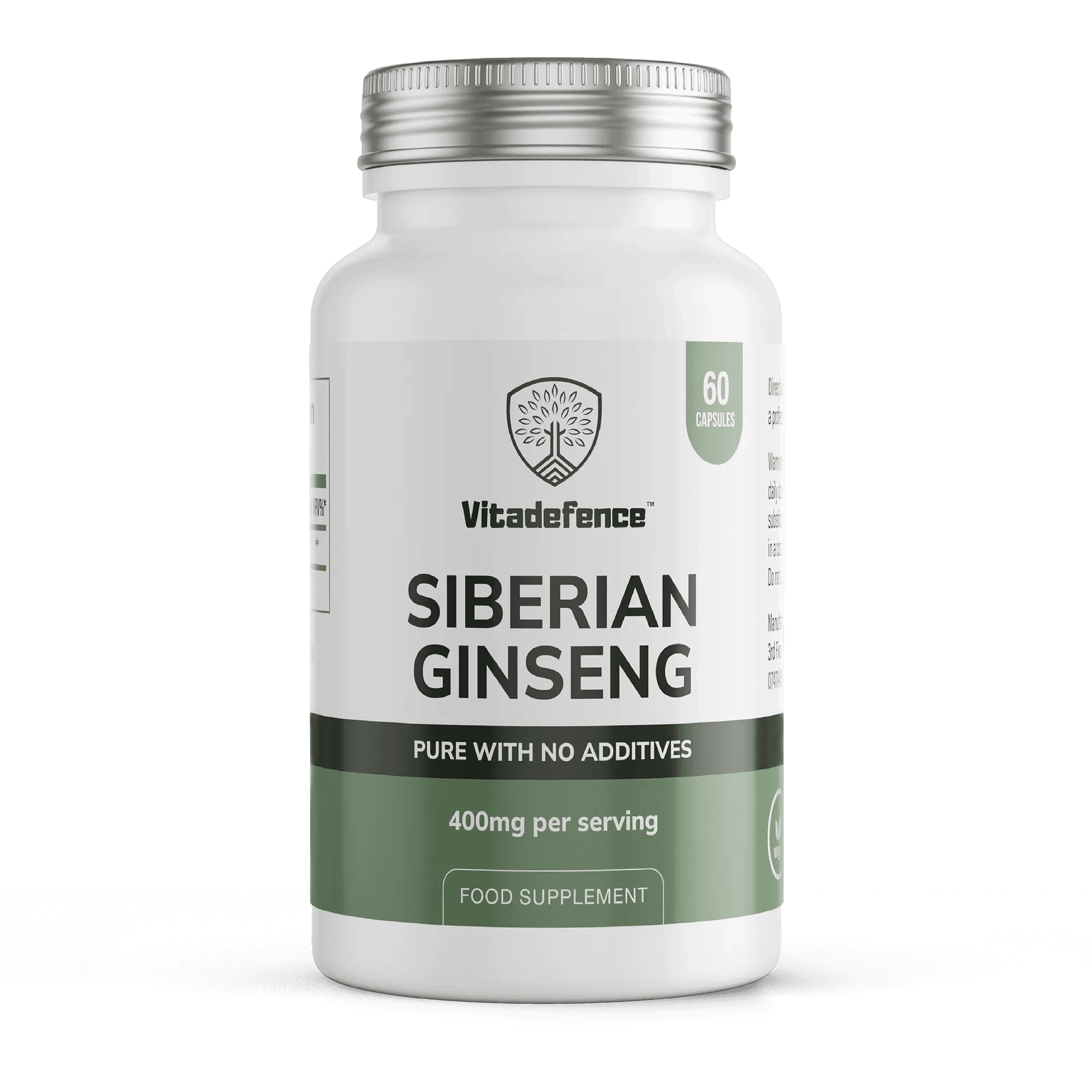
Our Eleutherococcus extract is sourced from a European Pharmacopoeia-aligned supplier, standardised to ≥0.8% eleutherosides B+E by HPLC. DER (drug-to-extract ratio) is stated on the supplier CoA. Each batch is released only after identity, purity, microbiological, and heavy-metal specifications are met. Manufacturing is in the UK under GMP.
Related reading
- EMA monograph EMA/HMPC/680618/2013 explained
- Siberian ginseng vs Korean ginseng — different chemistry, different markers
- GMP UK manufacturing — what it actually means
This regulatory information describes Eleutherococcus senticosus root in the context of traditional herbal medicinal products under EU Directive 2004/24/EC. Vitadefence Siberian Ginseng is sold as a food supplement under EU food law (not as a registered traditional herbal medicinal product). The EMA monograph is cited here as public regulatory context, not as a claim about our food supplement. This article is educational and based on the European Pharmacopoeia monograph for Eleutherococcus and publicly available analytical chemistry literature. It is not medical advice. Vitadefence products are food supplements and are not intended to diagnose, treat, cure, or prevent any disease.
Related products
More from the journal
Spirulina: The Original Superfood — Protein, B12, and Phycocyanin Antioxidant Power
9 min · Ingredients
Siberian Ginseng Benefits: Why This Adaptogen Is Different From Panax Ginseng
7 min · Ingredients