What the EMA Eleutherococcus Monograph Actually Says (EMA/HMPC/680618/2013)
The EMA's HMPC committee writes monographs that decide what a herbal product can legally claim. Eleutherococcus has one. Here is the plain-English version of what the monograph permits, what it forbids, and the dose range it lists.
By Vitadefence Team

If you have ever read a Siberian ginseng product label and wondered which claims are allowed and which are marketing, the answer is in one document: the European Medicines Agency Committee on Herbal Medicinal Products assessment EMA/HMPC/680618/2013. It is not a marketing brochure. It is a regulatory text that decides what an Eleutherococcus product can lawfully say in the European Union.
What the HMPC is and why it matters
The HMPC — Committee on Herbal Medicinal Products — sits inside the European Medicines Agency. Its job is to assess herbal substances and decide whether the documented use is sufficient to recognise a 'traditional herbal medicinal product' status under EU Directive 2004/24/EC. The decision is published as a monograph plus an assessment report. The monograph for Eleutherococcus was finalised in 2014.
What the monograph recognises
The monograph permits Eleutherococcus senticosus root and rhizome to be marketed as a traditional herbal medicinal product for the indication: "relief of symptoms of asthenia such as fatigue and weakness." The wording 'asthenia' is the medical term; in plain English it means a state of generalised weakness, low energy, slow recovery — typically associated with periods of demanding physical or mental effort, convalescence, or temporary stress.
Critical detail: the monograph specifies traditional use, not clinical efficacy. The legal basis is documented use of more than 30 years, of which at least 15 in the EU. The HMPC reviewed the available clinical literature and concluded that the data, while suggestive, does not meet the threshold for a 'well-established use' indication. Traditional-use is a lower legal bar but a perfectly valid regulatory category.
What the monograph does NOT permit
Disease prevention, cure, or treatment claims. Stress-cure marketing. Boosts-immunity language. Specific quantitative effect sizes. Any wording that implies disease modification. Any claim outside the listed indication.
The monograph also does not extend to other Eleutherococcus species (only E. senticosus), and it does not cover Panax ginseng (which has its own separate monograph).
The dose ranges listed
The monograph lists acceptable preparations and dose ranges for traditional-use products. For dry extract DER 13-25:1 (extracted with ethanol 30-40% V/V), single dose is 90-180 mg, daily dose 270-450 mg, divided into 1-3 single doses. For chopped or powdered root in tea form, single dose 0.5-4 g, daily dose 0.5-12 g divided across 1-3 administrations.
The 400 mg per capsule figure used in many European supplement products falls inside this range and is the practical reason the European market converged on 400 mg as a standardised single dose.
Duration limits
The monograph specifies that traditional Eleutherococcus products should not be used continuously for more than 2 months without a healthcare-professional review, and not in pregnancy, breastfeeding, or in children under 12. These are explicit precautionary statements drawn from the documented use record.
Pharmacovigilance
Reported adverse effects in the assessment included occasional insomnia (when taken late in the day), irritability, mild gastrointestinal complaints, and palpitations at high doses. The HMPC concluded that adverse effects are uncommon at the listed dose range and that the benefit-risk balance for traditional use is acceptable.
What this means for an honest label
A regulator-aligned Eleutherococcus product label should:
- Specify the species (Eleutherococcus senticosus) and the part used (root and rhizome).
- State the extract ratio (DER) and any standardisation marker (eleutherosides B and E are typical).
- Provide a dose within the monograph range — typically 200-400 mg per capsule.
- Include the precautionary statements: not for pregnancy, lactation, under-12s; do not use continuously beyond 2 months without review.
- Avoid disease, prevention, cure, treatment language.
- Use the EMA-recognised wording 'symptoms of asthenia such as fatigue and weakness' if a use indication is stated.
How Vitadefence Siberian Ginseng aligns
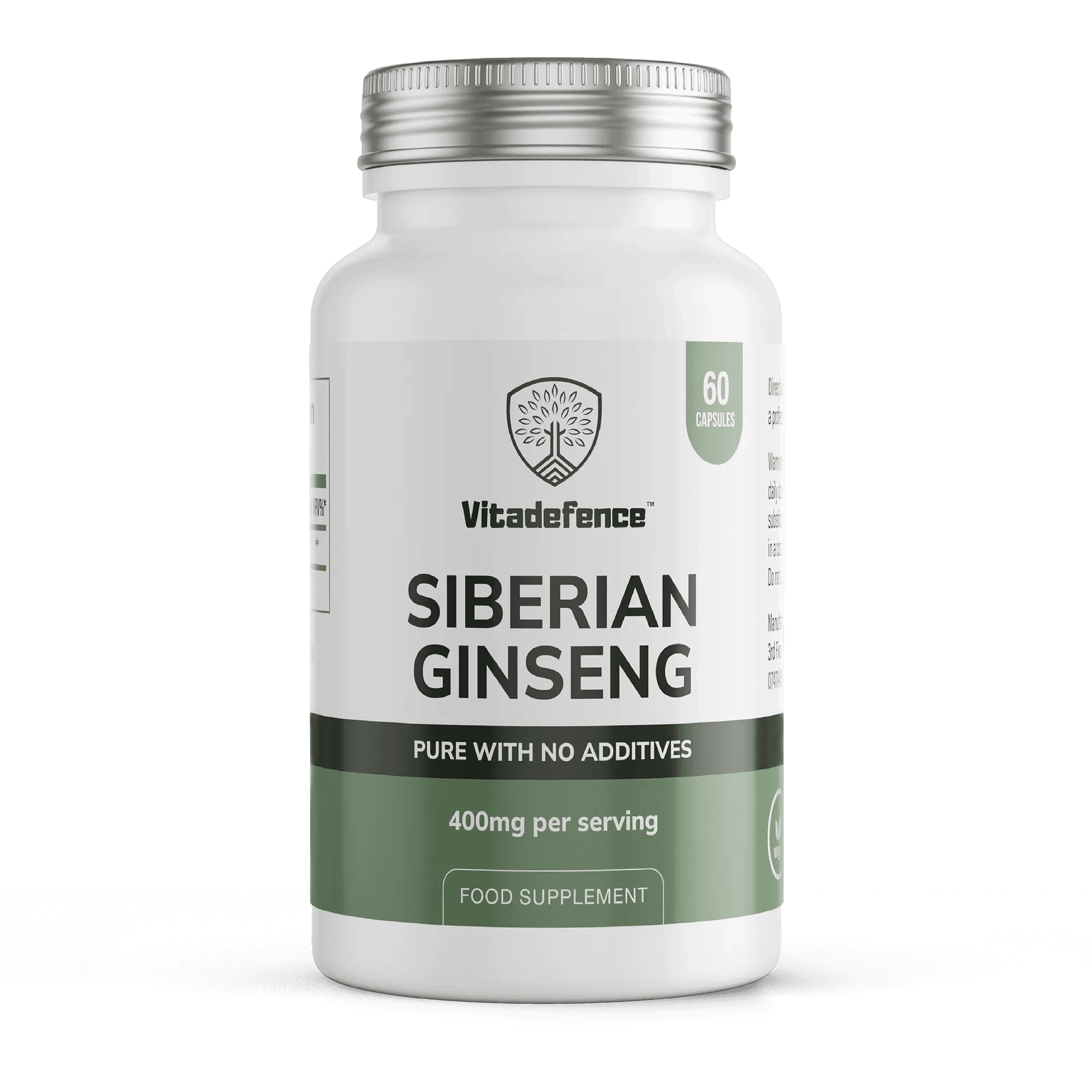
Our Siberian Ginseng product is Eleutherococcus senticosus root extract, 400 mg per capsule, in plant-based HPMC capsules, manufactured in the UK under GMP. Daily dose is one capsule per day, which sits at the lower end of the EMA monograph range. Our label and our blog content stay strictly inside what the monograph permits — no disease language, no exaggerated effect sizes, no out-of-scope claims.
Where to read the monograph yourself
The full monograph and assessment report are publicly available on the EMA website. Search for 'Eleutherococcus senticosus monograph' on ema.europa.eu. The document number is EMA/HMPC/680618/2013.
Related reading
- Siberian ginseng vs Korean ginseng: the mistaken-identity story
- Eleutheroside chemistry: B, E, and why standardisation matters
- Why 400 mg became the European standard dose
This regulatory information describes Eleutherococcus senticosus root in the context of traditional herbal medicinal products under EU Directive 2004/24/EC. Vitadefence Siberian Ginseng is sold as a food supplement under EU food law (not as a registered traditional herbal medicinal product). The EMA monograph is cited here as public regulatory context, not as a claim about our food supplement. This article is educational and references publicly available EMA documentation. It is not medical advice. Vitadefence products are food supplements and are not intended to diagnose, treat, cure, or prevent any disease. The monograph EMA/HMPC/680618/2013 covers traditional use of Eleutherococcus senticosus root and rhizome only.
Related products
More from the journal
Spirulina: The Original Superfood — Protein, B12, and Phycocyanin Antioxidant Power
9 min · Ingredients
Siberian Ginseng Benefits: Why This Adaptogen Is Different From Panax Ginseng
7 min · Ingredients