Why 400 mg Became the European Standard Dose for Eleutherococcus
The 400 mg dose did not arrive by marketing accident. It is the result of a sequence: Soviet clinical practice, the European Pharmacopoeia, the EMA traditional-use monograph, and the practical economics of single-capsule daily dosing.
By Vitadefence Team
Open six European Eleutherococcus products and you will find five of them at 400 mg per capsule. That number is not a marketing convention. It is the convergence point of several decades of dose research, regulatory framing, and practical capsule sizing. Here is the chain.
The Soviet starting point: 2-4 ml of liquid extract
The original Soviet clinical practice used Eleutherococcus as a fluid extract — typically a 1:1 (mass:volume) ethanolic extract of the root. The standard daily dose was 2-4 ml, taken once or twice per day. At a 1:1 extraction ratio, 2-4 ml of fluid extract corresponds approximately to 2-4 g of dried root material per day.
This is the dose range used in the bulk of the Russian-language clinical literature from the 1960s onward. Most studies on workers, athletes, and convalescents in that period sit in this range.
The DER conversion to dry extract
Modern European supplement production uses dry, encapsulated extracts rather than fluid extracts. The conversion factor is the drug-to-extract ratio (DER). A 13:1 DER dry extract concentrates 13 g of dried root into 1 g of dry extract. So 2-4 g of root = approximately 150-300 mg of 13:1 dry extract.
Higher DER ratios (25:1 or 35:1) concentrate further. A 25:1 dry extract of 100 mg corresponds to 2.5 g of root.
The EMA monograph dose ranges
The EMA HMPC traditional-use monograph EMA/HMPC/680618/2013 lists the following preparations and dose ranges:
- Dry extract DER 13-25:1, ethanol 30-40% V/V. Single dose 90-180 mg. Daily dose 270-450 mg, divided into 1-3 doses.
- Powdered or chopped root in tea. Single dose 0.5-4 g. Daily dose 0.5-12 g.
The 270-450 mg daily dose for the dry extract bracket is the regulatory range. A 400 mg single capsule taken once a day sits inside that range.
Why 400 mg specifically?
Three converging factors:
- Inside the EMA range. 400 mg sits comfortably within the 270-450 mg daily-dose monograph range, with margin.
- Single capsule simplicity. A single capsule per day has the highest customer adherence. Multiple-capsule regimens drop off. 400 mg in one size 0 capsule is mechanically achievable for a 13-25:1 standardised extract.
- Industry convergence. Once a few major European brands settled on 400 mg, ingredient suppliers calibrated their standardised-extract dosages to a 400 mg single-cap fill, and the rest of the market followed.
What this means for the supplement label
A label reading 'Eleutherococcus senticosus extract 400 mg, standardised to ≥0.8% eleutherosides B+E, DER 13:1' is making three independent measurable claims: dose, marker concentration, and concentration ratio. The 400 mg is one number in a three-number specification. By itself, '400 mg of extract' is informative but not complete; with the DER and standardisation marker added, you have a fully specified ingredient.
Lower and higher doses — when they make sense
Below 200 mg per capsule of a 13-25:1 extract sits below the EMA single-dose floor, requiring multi-cap regimens to reach the daily range. Above 500 mg per capsule of the same extract pushes single-dose into the high end of the monograph range, requiring fewer caps but with less flexibility for dose-titration.
400 mg per capsule taken once a day is the sweet spot: simple regimen, inside the EMA range with margin, with the option to add a second cap later in the day if desired (still within the 450 mg ceiling).
Duration of use
The EMA monograph specifies that traditional-use Eleutherococcus products should not be taken continuously beyond 2 months without healthcare-professional review. This is a precautionary statement based on documented use, not a finding of harm. A common-sense regimen is 6-8 weeks on, 2-4 weeks off, repeating as needed. The not-during-pregnancy, not-during-lactation, not-under-12s precautions also apply.
How Vitadefence Siberian Ginseng matches
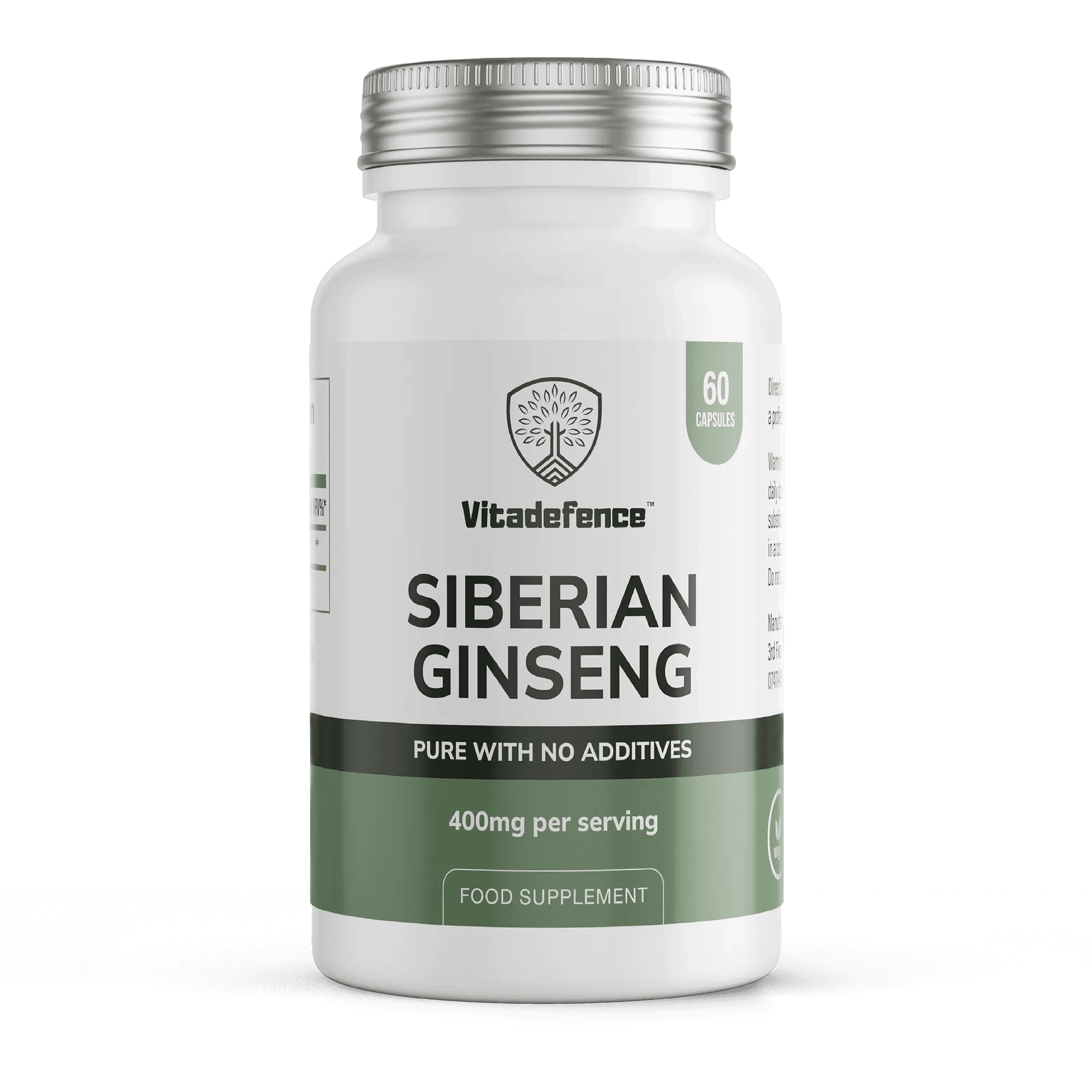
Our product is 400 mg of Eleutherococcus senticosus root extract per capsule, standardised to ≥0.8% eleutherosides B+E, in plant-based HPMC capsules. Daily dose: one capsule. This sits at the lower end of the EMA daily-dose range and matches the European 400 mg convergence pattern.
Related reading
This regulatory information describes Eleutherococcus senticosus root in the context of traditional herbal medicinal products under EU Directive 2004/24/EC. Vitadefence Siberian Ginseng is sold as a food supplement under EU food law (not as a registered traditional herbal medicinal product). The EMA monograph is cited here as public regulatory context, not as a claim about our food supplement. This article is educational and references the publicly available EMA HMPC traditional-use monograph EMA/HMPC/680618/2013 and Soviet-era pharmacological literature. It is not medical advice. Vitadefence products are food supplements and are not intended to diagnose, treat, cure, or prevent any disease. Consult a qualified healthcare professional before starting any new supplement, especially if pregnant, breastfeeding, or under medical care.
Related products
More from the journal
Spirulina: The Original Superfood — Protein, B12, and Phycocyanin Antioxidant Power
9 min · Ingredients
Siberian Ginseng Benefits: Why This Adaptogen Is Different From Panax Ginseng
7 min · Ingredients